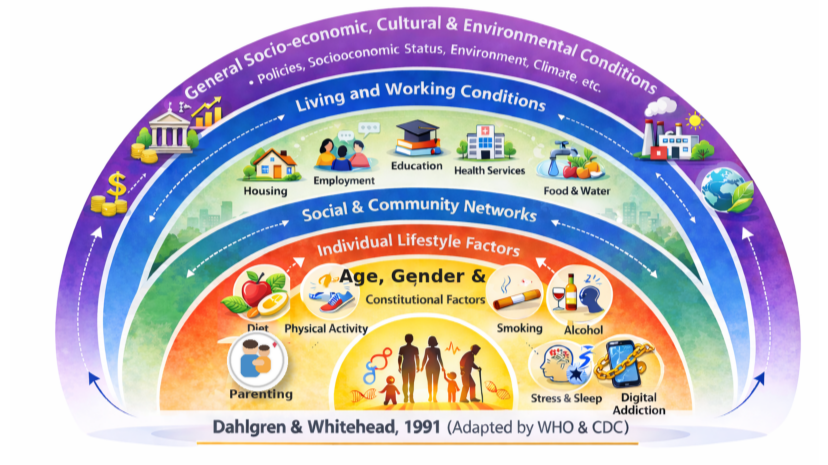
Health does not start in hospitals. It starts in the conditions we design around people every day — at home, in schools, at work, in the food we access, the air we breathe, the way we commute, and the media we consume.
Yet our health systems remain overwhelmingly focused on treatment after the fact. We wait for disease. We wait for crisis. We wait for burnout, breakdown, and chronic illness to appear — and then we intervene. This reactive model is not only costly, it's fundamentally misaligned with what we know about how health actually works.
Health Inequities Are Designed, Not Inevitable
The conditions that make people sick are avoidable, unnecessary, and unjust. They develop upstream — long before a patient ever walks into a clinic. Poor workplace design, long hours, chronic stress, lack of access to preventive care — these are the real drivers of disease.
And these conditions don't just affect the individual. Long hours and chronic workplace stress ripple into family dynamics, affecting parenting quality and the mental health environments children grow up in. The damage compounds across generations.
"Health does not start in hospitals. It starts in the conditions we design around people every day."
The Economic Case for Prevention
The evidence is clear and compelling. Investing in prevention isn't just the right thing to do — it's the smart thing to do.
(UK Government Research)
Despite this, the vast majority of health budgets — both public and corporate — are still allocated to treatment, not prevention. We're spending money on ambulances at the bottom of the cliff instead of building fences at the top.
Prevention Across Every Level
At Jaydii Health AI, we believe prevention must be embedded at every level of the ecosystem — not as an afterthought, but as the default architecture of how we support health.
Individual
Mental health awareness and behaviour change before disease onset. AI-powered screening identifies predispositions and early needs — giving people tools to act before problems escalate.
Family
Preventive education and stress recognition at home. When one family member is supported, the entire household benefits — breaking cycles of stress and dysfunction before they take root.
Schools
Wellbeing literacy and early risk detection in educational settings. Students facing bullying, anxiety, sleep problems, and self-harm risks often stay hidden until crisis — Jaydii helps surface these signals early.
Workplaces
Risk management for performance and productivity. Employers who invest in upstream health see lower absenteeism, higher engagement, and reduced healthcare costs. Prevention isn't a perk — it's a business strategy.
Community
Scalable prevention and population-level intervention. When health tools are accessible, multilingual, and available 24/7, entire communities can shift from reactive crisis response to proactive wellbeing.
The Expanded Role of Psychologists
Psychologists are no longer confined to treating distress after the fact. Their role is expanding to manage upstream biopsychosocial risks — designing healthier environments, strengthening emotional literacy, and building the systems that prevent illness from developing in the first place.
This shift — from clinician to architect of wellbeing — is at the heart of what we're building at Jaydii Health AI and DexWellness.
This is where DexWellness and Jaydii AI belong.

A Call to Redesign
The future of health doesn't look like more hospitals, more prescriptions, or more crisis hotlines. It looks like redesigned systems that emphasise:
- Education over treatment — teaching people to recognise and manage risks before they become illness
- Schools and workplaces over clinics — meeting people where they already are, not waiting for them to seek help
- Environmental design over symptom management — fixing the conditions that create illness, not just the symptoms they produce
Prevention by design isn't a trend. It's the only sustainable path forward for workforce health, community wellbeing, and the healthcare systems that serve them.