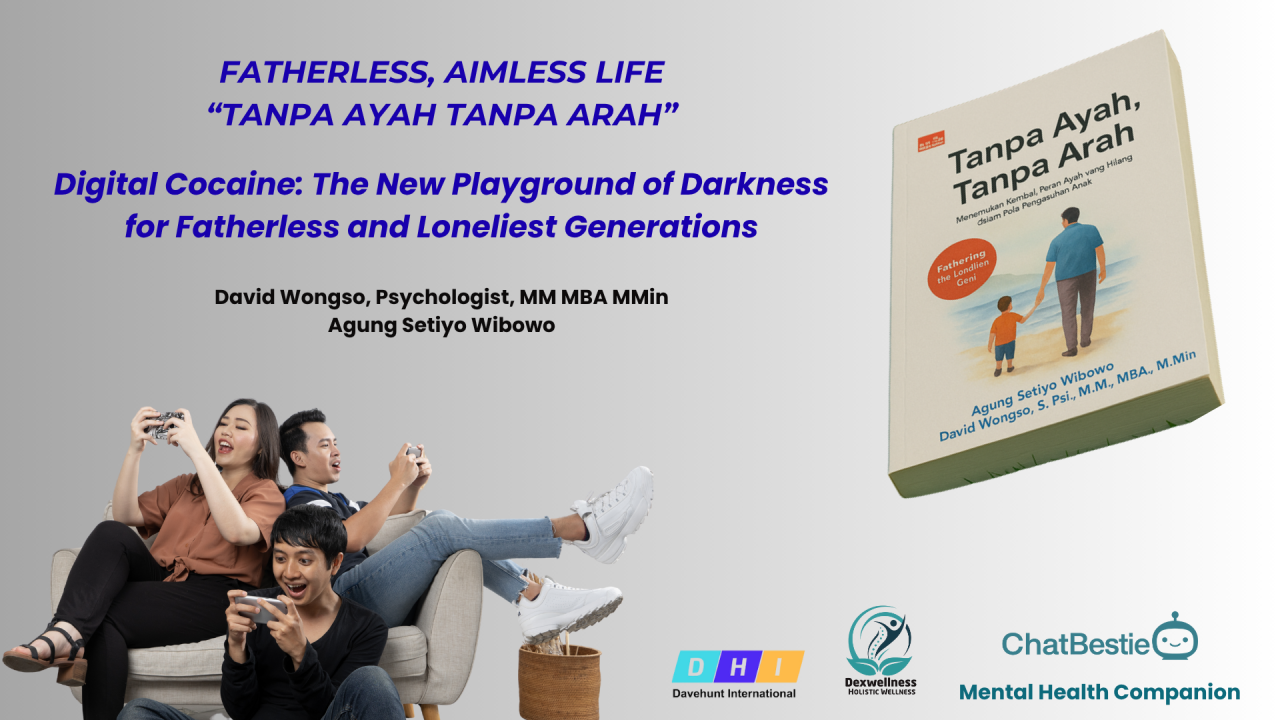
Excerpt from the new book: Tanpa Ayah, Tanpa Arah (Fatherless, Aimless Life)
On the evening of July 31st, 2025, in collaboration with the Alumni Association of Psychology, Universitas Padjadjaran (Ikatan Alumni Psikologi UNPAD), we held a thought-provoking book discussion on the theme of fatherlessness. The event was opened by the Vice Rector for Academic and Student Affairs, Prof. Zahrotur Rusyda Hinduan, S.Psi., MOP., Ph.D., and was attended by over 40 alumni and members of the public. For three hours, we engaged in deep conversation, Q&A, and reflection on the growing impact of absent fathers on mental, emotional, and spiritual well-being in today’s digital generation.
In an era where technology is at our fingertips 24/7, digital content has become a double-edged sword. While it offers information and entertainment, it also silently invades our homes and minds—especially targeting the most vulnerable: children and adolescents. When children feel bored, lonely, ignored, or emotionally disconnected from their parents—especially from absent or emotionally unavailable fathers—they often turn to social media, online gaming, and video content for comfort and affirmation. But what they find there is often not harmless fun, but a dark playground of digital cocaine—hyper stimulating, addictive, and soul-numbing.
“This is not just a parenting issue. It is a generational and societal crisis. Children are being emotionally raised by algorithms designed for profit, not for protection.”
They are exposed to violence, pornographic content, unrealistic beauty standards, and toxic ideologies before they are emotionally equipped to process or resist. As their screen time increases, we see a parallel decline in physical activity, reading and writing ability, empathy, face-to-face communication skills, attention span, and even spiritual awareness. Loneliness, depression, and anxiety are no longer rare—they are becoming normalised.
The roots often trace back to fatherlessness—not only the physical absence of fathers but emotional, spiritual, and intentional absence. A generation growing up without strong, engaged father figures is more vulnerable to chasing identity in the digital world. And as we disconnect from family presence and spiritual grounding, we become increasingly susceptible to external validation from strangers online. The screen becomes a substitute for belonging, affirmation, even love.
“The long-term cost? A generation that may be digitally fluent but emotionally fragile, cognitively distracted, and spiritually empty.”
The silent decline of holistic wellbeing—physical, mental, social, and spiritual—is one of the most dangerous consequences of unchecked digital overexposure. And the question is no longer just “how much screen time is okay?” but “Who is truly raising our children?”
The Way Forward: Restoring Presence, Protection, and Purpose
The solution is not to reject technology, but to reclaim intentional fatherhood and family-centred living. Children need fathers who are not just providers, but protectors, guides, and spiritual anchors. Presence, affection, active listening, and moral direction from a father figure can powerfully counterbalance the temptations of the digital jungle.
Parenting in the digital age also requires community-wide and systemic support:
- Governments and tech platforms must take responsibility in regulating harmful content and implementing stronger child protection measures.
- Schools, churches, mosques, temples, and community centres must work together to educate children about digital literacy and emotional resilience.
- More public spaces and facilities—parks, libraries, sports grounds—where children and families can bond away from screens.
Finally, family-friendly policies in the workplace are essential. Employers and governments must enable fathers and mothers to have time, flexibility, and emotional bandwidth to raise their children meaningfully. Hybrid work policy, with 2–4 hours wasted daily commuting in traffic jams, could provide extra time for parenting. Regulation on social media for under 16. Enforcement for porn and gambling dark webs. Family wellness should be seen as an investment in national human capital, not just a private matter. Because when the family breaks down, society pays the price.
“Strong Father, Stronger Family, Stronger Nation.”
This article is based on themes explored in the new book “Tanpa Ayah, Tanpa Arah”—a sobering reflection on how fatherlessness contributes to today’s mental health, spiritual disconnection, and generational confusion.