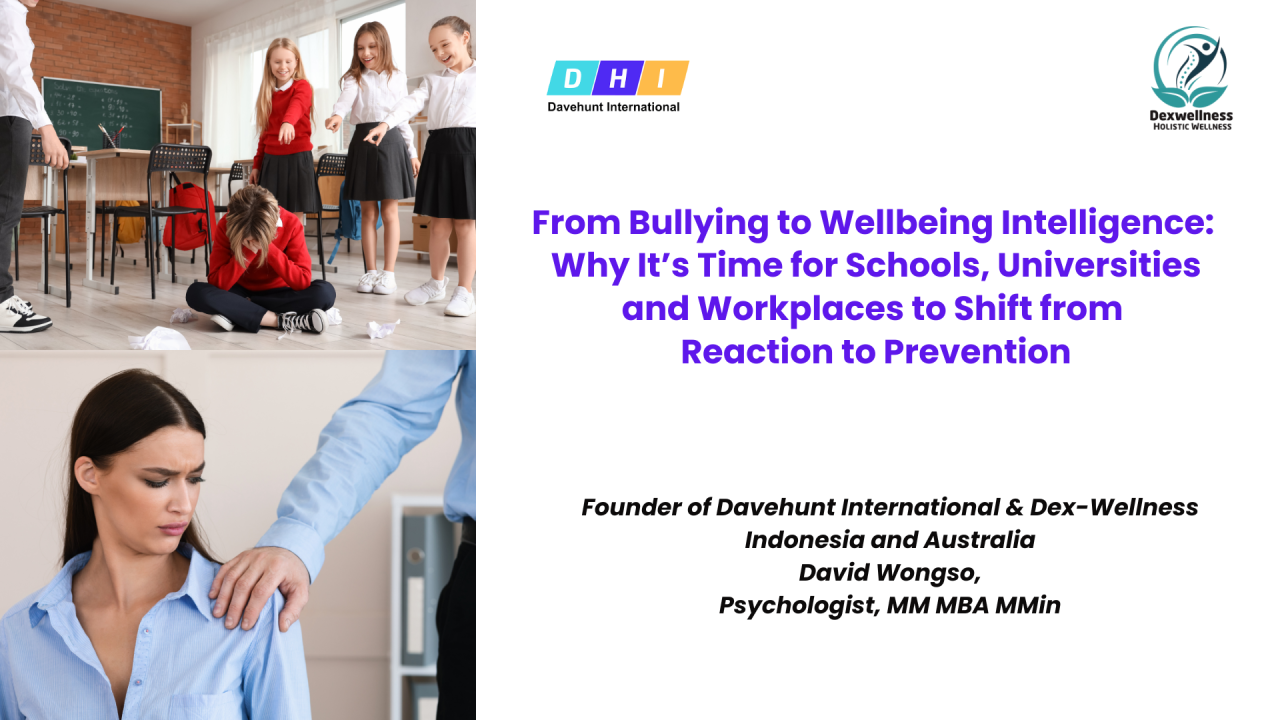
This article is based on slides delivered at the Indonesia Human Capital & Beyond Summit (IHCBS) 2025, and expanded in the Wellbeing Intelligence Workshop in Melbourne, 21 November 2025. It is written for leaders who shape systems — policy makers, board members, HR leaders, educators, and psychologists.
The Global Reality We Can’t Ignore
“Psychological wellbeing is no longer a ‘soft issue’ — it is a core governance and productivity imperative.”
The Crisis–Reaction Loop
Most institutions — both schools and corporations — still operate in a crisis and reactive mode:
- Intervening after burnout
- Creating new policies after a bullying case goes viral
- Providing counselling after depression or dropout
- Responding only when a case of self-harm occurs
This reactive cycle is financially costly, humanly delayed, and reputationally destructive. It’s time to shift from reaction to prediction, from crisis to prevention, from compliance to compassion.
The Psychological and Social Roots of Bullying
Bullying is not random. It is the manifestation of power imbalance, insecurity, and unhealed emotional wounds. Individuals who once felt powerless often replicate dominance as a means of control. Key roots include:
- Chronic insecurity and need for validation
- Lack of empathy caused by competitive cultures
- Early exposure to harsh parenting or humiliation
Studies by Eurofound (2024) found bullying prevalence escalates in hierarchical, fear-driven workplaces lacking psychological safety.
Cultural and Organisational Factors that Sustain Bullying
Bullying thrives not because there are many bullies — but because the culture permits it:
- Overemphasis on hierarchy and seniority
- Culture of silence and avoidance
- Permissive leaders who ignore misconduct for short-term results
- Reward systems that prize outcomes over ethics
The Social Mechanisms that Keep Bullying Alive
Bullying persists through powerful yet invisible mechanisms:
- Moral rationalisation: “It’s just a joke”
- Silence culture: witnesses fear exclusion
- Normalisation: unchecked behaviour becomes accepted
- Dependence on toxic high-performers
“Without accountability and empathy, bullying becomes institutionalised cruelty disguised as culture.”
Changing the Culture: From Compliance to Character
Transforming culture requires more than policies — it demands values, leadership, and consistency:
- Empathic and courageous leadership
- Transparent anti-bullying policies
- Emotional literacy and assertive communication training
- Psychological safety audits
- Collaboration across HR, psychology, and risk management
Examples like Brodie’s Law (Australia, 2011) and harcèlement moral (France) prove that nations can regulate psychological harm as seriously as physical safety.
Wellbeing Intelligence: The Next Frontier of Human Capital Governance
If The Lancet Psychiatry (2023) is correct that 1 in 2 people will experience a mental disorder before age 75, then wellbeing must move from optional to operational.
This is what we call Wellbeing Intelligence — an organisational capability to detect, map, and act on wellbeing risks in real time.
At DexWellness, we provide end-to-end advisory and solutions for building Wellbeing Intelligence Systems — enabling institutions to:
- Conduct psychosocial screening at entry points
- Integrate multi-dimensional wellbeing data
- Deploy data-driven interventions
- Develop empathic leadership
- Embed wellbeing within ESG and governance frameworks
Indonesia’s Moment of Decision
Indonesia faces rising cases of depression, burnout, and youth self-harm, yet mental health spending remains below 2% of total health budgets (WHO, 2024). To respond effectively, the nation must:
- Expand occupational safety to include psychological safety
- Mandate wellbeing screening and early detection
- Integrate AI and data analytics for predictive modelling
- Build a National Wellbeing Intelligence Ecosystem across sectors
Closing Reflection: From Silence to Stewardship
Every student, employee, and citizen carries not only credentials — but stories, scars, and potential. If Indonesia aspires to build a competitive, compassionate, and future-ready workforce, then Wellbeing Intelligence must become the backbone of its human capital strategy.
“Mental health is not a privilege. It is the infrastructure of national productivity.”